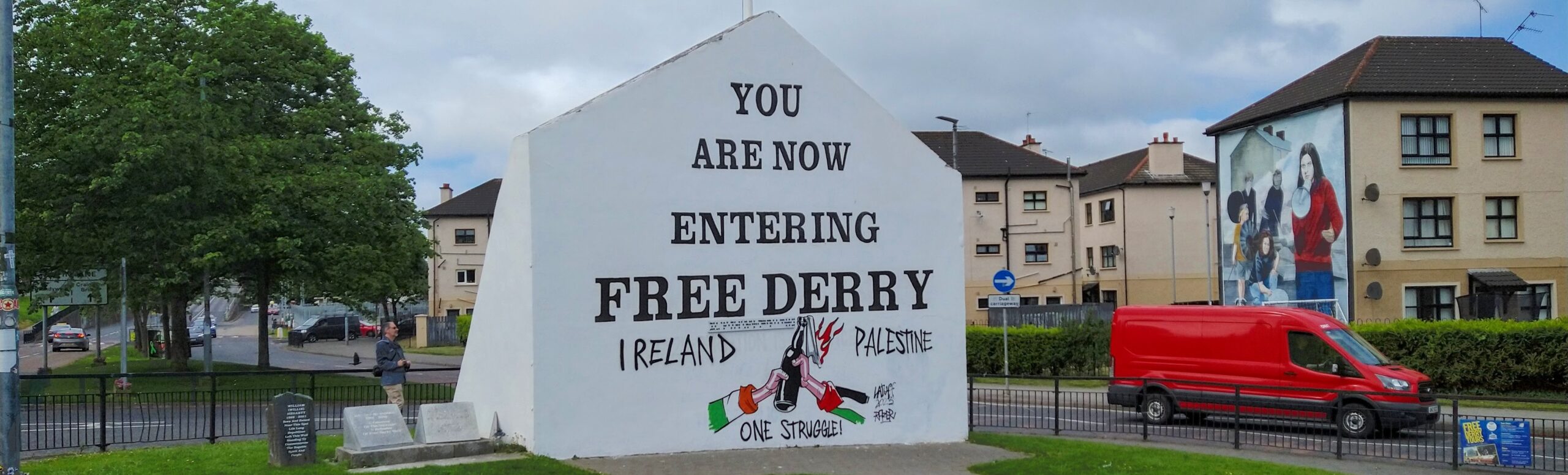
Northern Ireland
One cannot talk about Northern Ireland without talking about The Troubles.
Tuesday, we picked up a rental car. Fortunately, the rental place is a half mile from the motorway, so I didn’t have to drive on the wrong side of the car on the wrong side of the road with a manual transmission through Dublin’s heavy traffic.
We headed north to Belfast, known, as they say, for the two Ts: Troubles and Titanic. After a night’s sleep, we were picked up in the morning by Brian, driving a black English-style cab.
When Ireland finally gained independence from the United Kingdom of Great Britain and Ireland in the 1920s, the UK kept 6 counties in the northeast corner of the island. During the 800 year occupation of Ireland, the British banned the Gaelic language and when England became Protestant, they banned the Catholic church. British settlers took the best land and established large agricultural holdings, businesses and cities. Much like they have done around the world. In Ireland, they had a large foothold in the north. So at independence, they kept the North.
Colonial oppression remained in place. The indigenous Catholic Irish could not own land, they could not vote. This discrimination lasted until the 1970s. Many were forcibly expelled to make room for British loyalists. Inevitably, this led to rebellion which turned violent from the late 1960s until a peace treaty was signed in 1998.
Brian the driver/guide of the black cab, took us first through the Orange, Protestant neighborhoods. The Orange are feeling under duress after recent elections which were won, for the first time, by the Green Sinn Fein party, who the Orange consider terrorists. The Union Jack was flying on many houses, and there were many militaristic posters and murals displayed. It was as if the Proud Boys dominated the neighborhood. They have a lot in common: both feel their special privileges threatened by equality. We visited a memorial garden with photos of Orange innocents killed in the Troubles, with lots of blaming of the IRA.
Brian then took us to a Green, Catholic neighborhood, which had murals and posters of fallen Catholics. There were many expressions of solidarity with oppressed people around the world, Palestinians, Rohinga, Uigers, and images of Martin Luther King, Nelson Mandela along with the IRA protesters. The atmosphere was much more relaxed, likely because unification with the rest of Ireland is inevitable.
The Orange and Green neighborhoods are separated by 30 foot high walls. The gates are closed at night.
After the tour, Brian dropped us at the ultra modern Titanic museum on the docks where the ill-fated ship was built. The museum covers everything Titanic: how it was built, who built it, the route it took en route to the iceberg, who survived and who died and how they found it. Very well presented.
Two days later in Derry, we had a tour of the old city walls, with locations of the Derry Girls and the site of Bloody Sunday where English paratroopers gunned down 13 unarmed protesters, most shot in the back as they fled. Medals were later awarded and all official investigations suspended for 100 years. Our guide was Gleann, whose father was one of the victims. No attempt at impartiality here. Unlike Belfast, which is majority Orange, Derry has always been heavily Green, ala Apartheid South Africa.
A final note: I have been using “Orange” and “Green” rather than “Protestant” and “Catholic” because the conflict is not about religious belief, it’s about power and cultural dynamics.